Total foreign direct investment into India rose 2 per cent to the "highest ever" $83.57 billion in 2021-22 on account of various measures like policy reforms and ease of doing business taken by the government, the commerce and industry ministry said on Friday. Total FDI comprises equity inflows, reinvested earnings and other capital. In 2020-21, the inflow stood at $81.97 billion. It was $74.39 billion in 2019-20 and $62 billion in 2018-19. "India has recorded the highest ever annual FDI inflow of $83.57 billion in 2021-22," the ministry noted in a statement.

Foreign Direct Investment to Asia reached record heights in 2011, according to the United Nations Conference on Trade and Development (UNCTAD) World Investment Report 2012.
The FDI in pension sector would move in tandem with the insurance sector, official sources said, adding that the revised norms would be incorporated in the Pension Fund Regulatory Authority Bill expected to be introduced in Parliament during the upcoming Budget session.

The main sectors that receive the maximum foreign inflows include services, computer software and hardware, telecommunications, trading, construction, automobile, and power.

A deep dive into Trump's new policy and what it means for Indian professionals and companies.
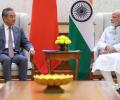
Former Army chief Gen M M Naravane (retd) said India-China ties are "on the mend" with initiatives announced at political, diplomatic and military levels. He expressed hope that China will reciprocate India's goodwill as they move forward in discussing the boundary question.

Indian growth in the rest of this fiscal year and next will be propelled by robust domestic consumption as consumer confidence improves, and by investment, including large increases in government capital expenditure, according to the Asian Development Outlook September 2023. "As slowing exports could foment headwinds for the economy, and erratic rainfall patterns are likely to undermine agricultural output, the growth forecast for FY2023 is revised down marginally to 6.3 per cent," ADB said.

In August 2011, the country had received foreign investment worth $2.83 billion.

The United Progressive Alliance government had opened the multi-brand retail sector for foreign investment and allowed up to 51 per cent foreign direct investment in the sector.

The company, which sells luxury products, including brands like Cartier, Piaget, Panerai and Montblanc, has also sought few clarifications from the government on conditions for selling sub-brands from the same stores, according to sources.

'One Chinese interlocutor said India should realise that "China can do without India, but India could not do without China", pointing to its inability to do without Chinese intermediates and components,' former foreign secretary Shyam Saran discovers on a visit to China.
'BSE has facilitated nearly Rs 35 trillion in capital raising across multiple segments.'

Foreign investment declined by 6.8 per cent year-on-year to $8.43 billion in September, ministry spokesman Shen Danyang told the media in Beijing.

The India-United States relationship is set to expand under the Donald Trump administration, but there could be some unease on issues like imports, tariffs and immigration, strategic affairs experts said after the Republican leader won the fiercely contested presidential election.
The GAAR provision will apply to entities availing tax benefit of at least Rs 3 crore.

India, the world's fifth largest economy in the world, is likely to overtake Japan to become the world's third-largest economy with a GDP of $7.3 trillion by 2030, S&P Global Market Intelligence said in its latest issue of PMI. After two years of rapid economic growth in 2021 and 2022, the Indian economy has continued to show sustained strong growth during the 2023 calendar year. India's gross domestic product (GDP) is expected to grow 6.2-6.3 per cent in the fiscal year ending in March 2024, being the fastest-growing major economy this fiscal year.

Market participants do not expect any immediate impact on the rupee from the Reserve Bank of India's (RBI's) a "comprehensive" master direction aimed at strengthening the framework for hedging foreign exchange risks. RBI Governor Shaktikanta Das, in his monetary policy statement, revealed that the central bank is poised to issue a master direction to consolidate guidelines for all types of forex transactions. But this development, according to market players, is more of a directional guidance than a mandatory directive.

The Commerce Ministry earlier this week commissioned a study to assess the impact of free trade agreement with South Korea, with which India had a trade deficit of about $9 billion in 2012-13.

Interrupting a two-month streak of decline, outward foreign direct investment (FDI) rose sequentially to $1.85 billion in July over $1.07 billion in June, an increase of 73 per cent. However, it was lower than the $2.18 billion in July last year, according to the Reserve Bank of India data. Outbound FDI, expressed as financial commitment, has three components - equity, loans, and guarantees.

'We may see even more restrictive policies during 2.0.'

The Reserve Bank on Thursday eased foreign direct investment (FDI) norms and allowed banks to provide guarantees on behalf of NRIs to acquire shares and debentures in Indian companies.

Equity benchmark indices Sensex and Nifty tumbled in early trade on Monday amid heightened tensions in the Middle East after the US bombed three major nuclear sites in Iran. The 30-share BSE Sensex tumbled 705.65 points to 81,702.52 in early trade. The 50-share NSE Nifty dropped 182.85 points to 24,929.55.

'India has intentionally taken advantage of the war in Ukraine to dramatically increase its purchases of Russian crude, when there are roughly 40 major crude providers that could satisfy Indian demand.'

The plan is to establish a consultative panel and appoint mediators to address various domestic issues, both at the central government and state levels.

Internet shutdowns by law enforcement agencies like the one in Manipur and Punjab cost $1.9 billion to the Indian economy in the first half of 2023, a report said on Thursday. The shutdowns also led to a loss of nearly $118 million in foreign investment and triggered over 21,000 job losses, the global non-profit Internet Society said in its report 'Netloss'. The non-profit arrived at the financial impact of the shutdown going beyond the loss of output and included factors like change in the unemployment rate, Foreign Direct Investment (FDI) lost, risks of future shutdowns, population in the working age etc.

A day after lambasting e-commerce players for predatory pricing, Union Commerce Minister Piyush Goyal on Thursday said he is not against online platforms but India wants such entities to be "fair and honest" in their conduct. Speaking with reporters in the financial capital, the outspoken Union minister said the rule of the law should be followed in letter and spirit, and made it clear that consumer preferences should not be influenced by algorithms.

He said the policy paralysis, which had gripped the country in recent months, was over, and India was back in business.

The Bharatiya Janata Party on Thursday sprung a surprise for the UPA-II and more so for Prime Minister Dr Manmohan Singh, who is championing the cause of Foreign Direct Investment, when it released a letter dated December 21, 2002, in which the prime minister had opposed FDI.

Foreign Direct Investment (FDI) equity inflows into India contracted by 14 per cent to $26.9 billion during the April-September this fiscal, according to the data of the Department for Promotion of Industry and Internal Trade (DPIIT). The inflows had stood at $31.15 billion during the corresponding period of the previous year. The total FDI inflows (which includes equity inflows, re-invested earnings and other capital) too declined to $39 billion during the first six months of the current fiscal year as against $42.86 billion in the year-ago period.

The outbound FDI is also expected to increase, resulting in net FDI inflow of $24 billion.
Foreign Direct Investment Confidence Index is a regular survey of global executives conducted by AT Kearney, a global management consulting firm.

Domestic institutional investors (DIIs), mostly mutual funds and insurance companies, overtook foreign portfolio investors (FPIs) in ownership of NSE-listed companies in the March quarter of 2025. According to Prime Database, DIIs held a 17.62 per cent stake, up from 16.89 per cent in the December 2024 quarter.

Kohler made the comments on aviation industry-wide speculation about New Delhi increasing FDI in defence sector to 49 per cent from the current 26 per cent, with some expecting an announcement in the near future.

The Union Cabinet on Wednesday gave its nod for amendments in the Insurance Act, paving way for 74 per cent foreign direct investment in the sector. Currently, the permissible FDI limit in the life and general insurance stands at 49 per cent with ownership and management control with Indian. According to sources, the Cabinet in its meeting has approval for amendments in the Insurance Act, 1938.

The Union Cabinet is expected to soon consider a proposal to increase foreign direct investment cap in broadcasting services like Direct-to-Home and cable TV networks to a uniform 74 per cent.

According to Indian Staffing Federation, an apex body of the flexi staffing industry in India, foreign direct investment in retail can create around 4 million direct jobs and almost 5 to 6 million indirect jobs, including contractual employment within a span of 10 years.
Terming the prime minister's address to the nation on September 21 as "most laughable", Shiv Sena chief Bal Thackeray said Manmohan Singh has "shamelessly" defended Foreign Direct Investment (FDI) in retail and rise in diesel prices.

Reliance 4IR Realty Development, a unit of Mukesh Ambani's Reliance Industries, paid a Rs 86.5 crore 'development fee' to license the Trump brand for a forthcoming real estate project in Mumbai.

India's craft chocolate makers are changing the market by using local cacao, creating bold new flavours, making chocolate both a luxury and a story.

The share of foreign companies in private sector investments, directed towards building new factories and other facilities, has declined over the past six months. A mix of large domestic announcements and relatively lower growth in foreign capital expenditure (capex) plans have played a role, although foreign investments remain near record levels. The share of foreign companies in the overall private sector investments over the four quarters ended June 2023 has dipped to 14.9 per cent, as shown by a Business Standard analysis of data from the project tracker Centre for Monitoring Indian Economy.
